
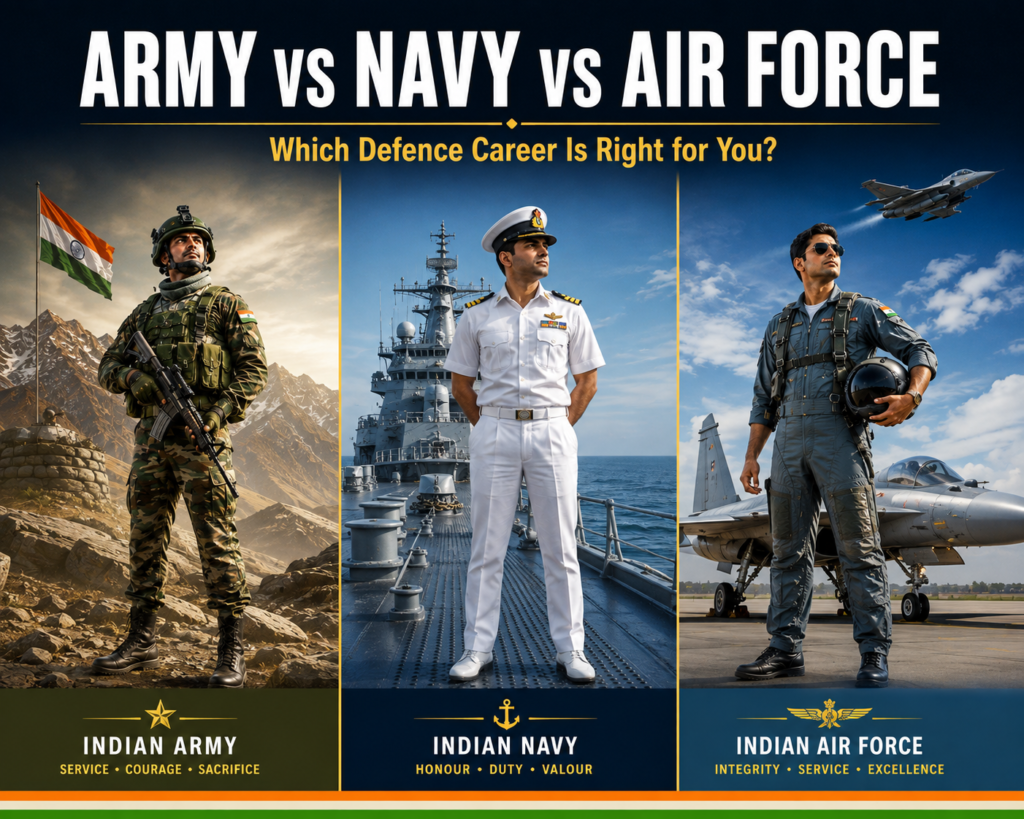
You’ve just cleared your 12th boards, and somewhere between the excitement and the relief, one big question keeps popping up — should you join the Army, the Navy, or the Air Force? If you’re reading this in Nagpur, or anywhere else in India, chances are you’ve already asked a dozen people this same question and gotten a dozen different answers.
Here’s the truth: there’s no single “best” force. There’s only the force that’s best for you. This blog breaks down Army vs Navy vs Air Force after 12th in a simple, practical way — covering roles, entry routes, eligibility, salary, lifestyle, and career growth — so that by the end, you’ll have a much clearer picture of where you belong.
Why Is Choosing Between Army, Navy, and Air Force So Confusing?
Almost every defence aspirant faces this dilemma at some point during their preparation. Part of the confusion comes from the fact that all three services offer similar respect, similar pay scales, and similar pride of serving the nation. On the surface, they look almost identical in value — which makes the decision harder, not easier.
But dig a little deeper, and the differences become obvious. The Army, Navy, and Air Force operate in completely different environments, demand different skill sets, and offer very different day-to-day lives. Understanding which defence career is best after 12th isn’t about picking the “top” branch, it’s about matching the branch to your personality, interests, and long-term goals. In fact, when people search for the best defence job in India, they’re usually really asking this same question in different words. That’s exactly what we’ll help you answer here, and if you’re just starting out, it also helps to first understand how to prepare for NDA before diving into branch-specific decisions.
The Three Pillars of Armed Defence
India’s national defence stands on three forces — the Army, Navy, and Air Force — together known as the Armed Forces of India. Each one guards a different front (land, sea, and sky), and together, they make sure the country stays protected from every direction.
Indian Army
The Army is the largest of the three forces and takes care of land-based defence. It guards India’s borders, handles counter-insurgency and internal security, and steps in during natural disasters to help civilians. After 12th, you could join as an Infantry Officer, Artillery Officer, Engineer Officer, Signals Officer, or in roles like Army Aviation and Logistics. It’s a career built around leadership, ground command, and hands-on action.
Indian Navy
The Navy protects India’s coastline, sea routes, and maritime borders. It’s responsible for keeping the ocean around India secure. A Navy career after 12th could lead you to roles like Executive Officer, Naval Pilot, Marine Engineer, Electrical Officer, or Submarine Officer. This branch suits students drawn to ships, marine technology, and life at sea.
Indian Air Force
The Air Force guards Indian airspace. It handles air combat, aerial surveillance, and airlift operations — moving troops and supplies quickly by air when needed. After 12th, you could work toward becoming a Fighter Pilot, Transport Pilot, Air Traffic Control Officer, or join a technical or ground duty branch. It’s a career built on precision, speed, and advanced technology.
Together, these three forces form India’s complete defence system — the Army defends the land, the Navy defends the seas, and the Air Force defends the skies. If you’re wondering whether NDA is your only route into one of these forces, it’s worth also exploring other ways to become an officer. Understanding this basic role of each is the first step before deciding which one fits you best.
Army vs Navy vs Air Force: Quick Comparison Table
Here’s a side-by-side snapshot to make the Army vs Navy vs Air Force after 12th comparison easier to digest at a glance.
| Factor | Indian Army | Indian Navy | Indian Air Force |
|---|---|---|---|
| Work Environment | Land, borders, field areas | Sea, ships, submarines | Air bases, aircraft, sky |
| Ideal Stream | Any (PCM for TES) | PCM preferred | PCM for technical, any for non-technical |
| Physical Demand | Very high | Moderate to high | High (extreme for pilots) |
| Technology Exposure | High | Very high | Very high |
| Operational Domain | Land | Sea | Air |
| Entry Vacancies | Highest among the three | Moderate | Lowest, most competitive |
| Best Suited For | Field leaders | Maritime and technical professionals | Aviation enthusiasts |
Life in the Army vs Navy vs Air Force: What Daily Life Looks Like
This is often the most underrated factor when comparing the three services. Salary numbers look similar on paper — daily life is where the real difference lies.
Life in the Indian Army
- Frequent postings — from high-altitude Himalayan stations to desert outposts and border regions
- Deployments can be physically demanding, especially in field and high-altitude areas
- In field postings, families often stay behind rather than relocating with you
- What you gain in return: deep camaraderie, early leadership responsibility, and a life shaped by discipline and grit
Life in the Indian Navy
- Life alternates between shore postings in port cities like Mumbai, Visakhapatnam, and Kochi, and sea duty
- Sea deployments can last weeks or months at a stretch
- During deployments, you’re largely cut off from regular communication with family
- In exchange, you get international exposure through port visits and joint exercises — something the other two branches rarely offer to this extent
Life in the Indian Air Force
- Generally considered the most structured and comfortable lifestyle of the three
- Air bases are well-maintained and often located near cities
- Good schools and housing typically available for families
- Pilots follow a demanding flying schedule; ground duty officers work in more predictable, office-like environments
Career Growth and Rank Progression in All Three Forces
Understanding Army vs Air Force vs Navy ranks and how promotions work is useful before you commit to a branch.
Army Rank Hierarchy Lieutenant → Captain → Major → Lieutenant Colonel → Colonel → Brigadier → Major General → Lieutenant General → General. The Army has the largest officer cadre, so while entry vacancies are higher, competition for top ranks is intense.
Navy Rank Hierarchy Sub-Lieutenant → Lieutenant → Lieutenant Commander → Commander → Captain → Commodore → Rear Admiral → Vice Admiral → Admiral. With a smaller officer cadre than the Army, promotions can sometimes move a little faster.
Air Force Rank Hierarchy Flying Officer → Flight Lieutenant → Squadron Leader → Wing Commander → Group Captain → Air Commodore → Air Marshal → Air Chief Marshal. The Air Force has the smallest officer cadre of the three, which makes senior ranks the most competitive to reach.
Interestingly, ranks across the three services are equivalent at each level — for instance, an Army Colonel, a Navy Captain, and an Air Force Group Captain hold the same seniority, even though the titles sound different.
Mistakes to Avoid While Choosing Your Defence Branch
Many students end up choosing a branch for the wrong reasons. Some common mistakes to avoid — and a good reference point here is our breakdown of common myths about NDA, which covers several of these misconceptions in more depth:
- Choosing a branch because a friend or relative is already in it
- Following trends without genuinely understanding the role
- Ignoring eligibility criteria like stream requirements or medical standards
- Underestimating lifestyle differences until it’s too late to adjust
- Focusing only on salary and ignoring day-to-day working conditions
Avoiding these mistakes early makes the entire decision-making process and your preparation much smoother.
How to Choose Between Army, Navy, and Air Force
Once you understand the eligibility criteria, roles, and lifestyle of each service, the real decision comes down to fit — how well a branch matches your interests, strengths, and long-term goals.
Identify What Actually Interests You
Set salary and prestige aside and think honestly about the kind of work you’d enjoy day to day.
- Army — if you’re drawn to ground leadership, field operations, and hands-on command roles.
- Air Force — if aviation, technology, and technical systems excite you more than anything else.
- Navy — if the idea of ships, maritime operations, and life at sea genuinely appeals to you.
Choose based on what interests you, not pressure from friends, family, or social media.
Understand the Lifestyle Differences
Each branch comes with a distinct day-to-day life, and this matters as much as the job itself. Ask yourself:
- Can I adapt to long deployments or extended postings?
- Do I enjoy outdoor, physically demanding challenges?
- Am I comfortable working with advanced technical systems?
- Does the idea of extended time at sea suit me, or would I rather be based on land?
Assess Your Physical and Technical Strengths
Be realistic about where you currently stand and what you’d need to build up.
- Army roles generally demand higher physical endurance and stamina under demanding conditions.
- Air Force roles call for strong aptitude in mathematics, science, and technology, especially for aviation and technical trades.
- Navy roles need a mix of technical understanding and operational readiness, plus the ability to adapt to life at sea.
Learn From People With Defence Experience
- Speak with serving or retired defence personnel whenever possible.
- Ask about their day-to-day responsibilities, postings, challenges, and lifestyle.
- Use their first-hand experiences to understand aspects of service life that a general comparison may not cover.
How Defence Service Academy (DSA) Helps You Choose the Right Career
Comparing the three services on paper is a good starting point, but choosing your branch and then actually clearing NDA, CDS, or SSB is a different challenge — one that needs the right guidance.
At Defence Service Academy (DSA), we help students in Nagpur go beyond comparisons. Our counselors sit down with every aspirant to understand their interests, physical strengths, academic stream, and long-term goals — so the branch they choose is one they’ll genuinely thrive in, not one picked out of confusion or peer pressure.
Once that clarity is in place, DSA’s structured NDA, CDS, and SSB coaching takes over — covering the exam syllabus, physical fitness training, and the personality development needed to clear the SSB interview.
Here’s how DSA supports you at every step:
- Personalised career counselling to identify the right branch for your profile
- Subject-wise NDA and CDS coaching from experienced faculty
- Dedicated physical training to meet each branch’s fitness standards
- SSB interview preparation, including GTO tasks, psychological tests, and personal interviews
- Regular mock tests and performance tracking to monitor real progress, as part of our structured batch selection process
Whether your interest lies in the Army, Navy, or Air Force — and whether you’re a boy or a girl exploring our NDA coaching for girls — Defence Service Academy ensures you’re not just choosing the right path, you’re prepared to walk it. Our DSA results and selections reflect this track record.
FAQs
Q1: Which is the best defence career after 12th — Army, Navy, or Air Force?
There is no universally “best” branch. The right choice depends on your personal interests, physical strengths, academic stream, and the lifestyle you’re comfortable with. Each of the three services offers equal respect, career growth, and financial stability.
Q2: Can I choose my preferred force after clearing NDA?
Yes, candidates can indicate their preference for Army, Navy, or Air Force. However, final allocation depends on merit rank, medical fitness, SSB performance, and the number of vacancies available in each branch that year.
Q3: Is there a reserved seat quota for women in NDA?
Yes. Women candidates have separate vacancies in NDA, which are notified for each examination and service. However, this is not a reservation based on category such as SC, ST, or OBC. Women and men are considered through the common UPSC NDA examination and SSB process, with separate vacancies and merit lists for male and female candidates. The number of vacancies can vary from one NDA course to another based on service requirements.
Q4: Which branch has the best lifestyle and work-life balance?
The Air Force is generally considered to offer the most structured and family-friendly lifestyle, thanks to well-maintained bases near cities. The Navy offers a strong lifestyle in port cities but involves long sea deployments. The Army’s lifestyle is the most physically demanding, with frequent field postings.
Q5: How many years of training are required for NDA candidates?
NDA candidates undergo three years of joint training at the National Defence Academy, Khadakwasla, followed by service-specific training — one year at IMA Dehradun for Army, and varying durations at the Naval Academy or Air Force Academy for Navy and Air Force cadets.
CONCLUSION
At the end of the day, the debate around Army vs Navy vs Air Force after 12th isn’t really about which branch is “better.” All three offer respect, purpose, financial stability, and the pride of serving India. What matters is which one aligns with your personality, physical strengths, and the kind of life you genuinely want to live for the next 20–30 years.
Take the time to reflect on your interests, talk to serving or retired officers if you can, and get proper mentorship before committing to a preparation path. If you’re based in Nagpur and looking for structured guidance on NDA, CDS, or SSB preparation, contact DSA — Defence Service Academy can help you make this decision with far more clarity and prepare for it the right way from day one.
📍 No.6, National Highway, Tah+Dist:, Nandora, Shahapur, Maharashtra 441906
☎️ 7798644422 | 99750 63722
✉️ sgbscience@gmail.com
🌐 defenceservicesacademy.com/en/
 English
  हिन्दी